
Digital Patient Guidance as a Strategic Lever for Efficiency and Patient Experience

Healthcare digitalization is often discussed as a long term transformation. In reality, the greatest value emerges when everyday operational challenges are solved.
Hospitals and clinics operate in a challenging environment shaped by rising demand, staff shortages, cost pressure and increasing expectations regarding service quality.
Digital patient guidance creates impact exactly at this intersection. It provides immediate operational relief while establishing the foundation for sustainable development. The key lies in a step by step approach that delivers measurable value from day one.
Digitalization starts long before treatment
A significant share of organizational complexity arises before the first clinical interaction. Appointment confirmations, missing information and recurring questions create daily coordination effort and strongly influence the patient experience.
A key lever lies in digital registration, enabling hospitals to reach patients early and reliably.
Patients complete their registration well before admission instead of filling in admission forms on the day of treatment. Patient administration teams gain time to verify data and clarify open questions early in the process. This results in structured workflows, higher data quality and measurable operational relief.

The impact extends far beyond admission:
reliable and complete master data before the treatment day
early clarification of open administrative questions
improved patient reachability
accurate address and contact data supporting smooth billing processes
legally documented consent and information with digital timestamp
more stable downstream processes
High quality master data becomes a key driver of process efficiency across the entire patient journey.
Self Check in and intelligent admission flow
On the day of treatment, digital check in becomes a central steering mechanism.
The system verifies the internal status automatically. If administrative steps remain open, patients are guided directly to patient administration. If everything is complete, patients proceed directly to their appointment.
Operational impact:
reduced pressure on reception desks
shorter waiting times
structured admission workflows
improved scalability during peak times
Reception evolves from a data capture point into a service and support hub.

Integrated additional services and new revenue potential
Digital admission also enables integrated service offerings such as:
ward class upgrades
bookable additional services
organizational services around the hospital stay
These options integrate seamlessly into the process and create value for both patients and healthcare organizations.
Appointment management as a driver for operational excellence
Automated appointment communication improves preparation, punctuality and workflow stability.
Benefits include:
fewer phone and email inquiries
better prepared patients
smoother consultations
Automated confirmations reduce no shows. Selected clinics may also offer KIS integrated online booking to extend accessibility and reduce workload for scheduling teams.

Automated appointment invitations and patient tasks
After scheduling an appointment, patients automatically receive structured information and preparation tasks.
Results:
fewer phone and email inquiries
better prepared patients
smoother consultations
Appointment confirmations and selected online booking
Automated appointment confirmations improve attendance and reduce short notice cancellations.
For selected clinics, KIS integrated online booking can additionally be offered. This expands accessibility and reduces workload for patient scheduling teams.

On site navigation and digital patient calling
Digital calling systems create transparency and structure in waiting areas, reducing questions and improving patient orientation.
Digital patient calling systems create transparency and structure in waiting areas:
fewer questions at reception
calmer waiting zones
clear and easy to understand processes for patients

Low treshold communication around the clock
A growing share of patient interactions happens outside opening hours. Many requests relate to organizational questions and next steps.
AI powered assistants support first level communication, answer frequent questions and guide patients through administrative steps.

To name but a few benefits:
improved accessibility around the clock
reduced phone and email workload
faster patient orientation
From reception desk to digital patient journey
Instead of a paper based welcome, patients experience a personalized and digitally guided journey from the first contact to outpatient appointments or inpatient stays and beyond.
Healthcare teams gain more time for personal care, while patients benefit from structured processes, clear communication and modern guidance throughout their journey.
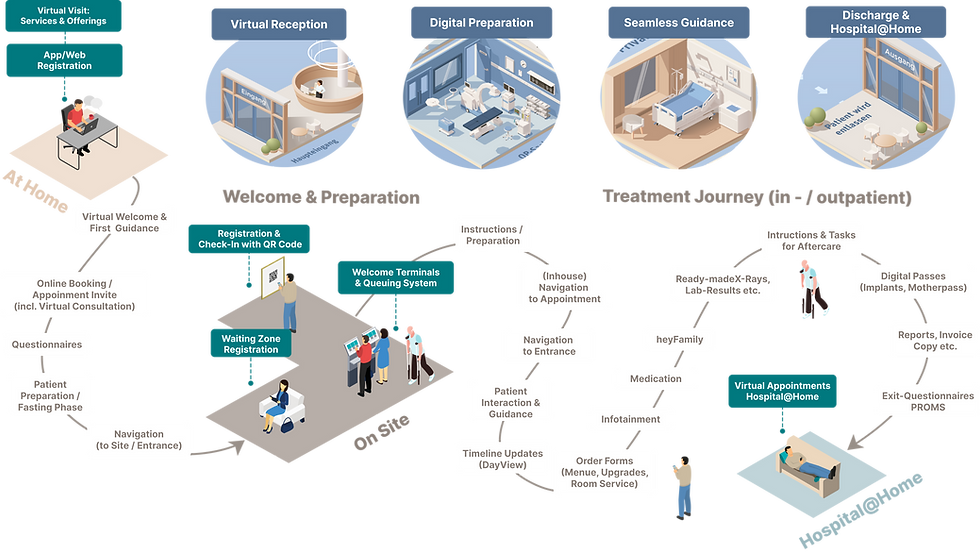
Conclusion: Operational relief as the starting point of transformation
The future of patient care emerges from the consistent optimization of everyday interactions. Digital patient guidance simplifies processes, relieves teams and improves data quality.
The impact becomes visible immediately in daily hospital operations while creating the foundation for the continued evolution of a fully digital patient journey.


Comments